Purpose
The purpose of this program is to address identified HIV care and treatment gaps among high-risk subgroups and work towards epidemic control in Zimbabwe through improving access to HIV prevention, care and treatment services for high-risk population in Zimbabwe. This project is under the Zimbabwe Partnership to Accelerate AIDS Control (ZimPAAC) consortium, where Pangaea Zimbabwe is a partner, working through direct support and established, sustainable and collaborative relationships with MOHCC, NAC and other stakeholders.
Target Population
High- risk Populations

Key Strategies
- Health system strengthening & capacity building: Train and mentor healthcare workers and community cadres to deliver friendly, inclusive services for high-risk populations and strengthen facility–community referral pathways.
- Biomedical HIV prevention & innovation: Scale PrEP (oral PrEP) literacy, initiation and continuation; pilot and create demand for new biomedical prevention products such as CAB-LA at public sector sites; expand HIV self-testing.
- Community engagement & demand creation: Use peer support groups, community cadres and integrated outreach to build trust, raise awareness and mobilise high-risk subgroups to access services.
- Integrated HIV care & treatment: Strengthen linkages between community platforms and OI/ART clinics to ensure timely initiation, retention and viral suppression.
- Mental health integration: Screen for common mental disorders and provide Problem-Solving Therapy (PST) using the Friendship Bench model as part of comprehensive care.
- Monitoring, data & quality improvement: Actively monitor PrEP continuation and ART outcomes, use data to inform program adjustments and sustain high-quality service delivery.
Major Activities
Capacity building
- Trained over 400 healthcare workers and 85 community cadres across 23 supported public sector facilities in Harare to deliver services friendly to high-risk populations.
- Strengthened facility readiness and community trust in specific public sector facilities, improving accessibility.
HIV prevention
- Condom distribution: Distributed over 2 million condoms across 85 sites.
- PrEP literacy & demand creation: Reached more than 10,000 high-risk subgroups with PrEP literacy sessions via face-to-face and virtual platforms.
- PrEP linkages & initiations: Linked at least 70% of HIV-negative individuals in high-risk subgroups to PrEP. PrEP initiations in the 20 supported districts increased from 1,815 in 2020 to 12,172 in 2024.
- PrEP continuation support: Actively monitored PrEP continuation and fostered community support through PrEP support groups achieving a 52% continuation rate at month 1.
- New biomedical prevention products: Created demand for CAB-LA, piloting it at 3 public sector sites.
- Result: Improved overall understanding of HIV prevention and reduced risky behaviour.
HIV care & treatment
- Delivered over 1,000 integrated outreach initiatives, engaging and educating 34,350 high-risk individuals on available HIV services.
- Distributed more than 4,000 HIV self-test kits through facility and community platforms.
- Screened more than 2,600 clients for STIs, with 99% linkage to treatment for the 875 (33%) who were STI-positive.
- Strengthened ART adherence and support through peer support groups, with at least 95% of group participants achieving undetectable viral load or low viremia.
Mental health & psychosocial support
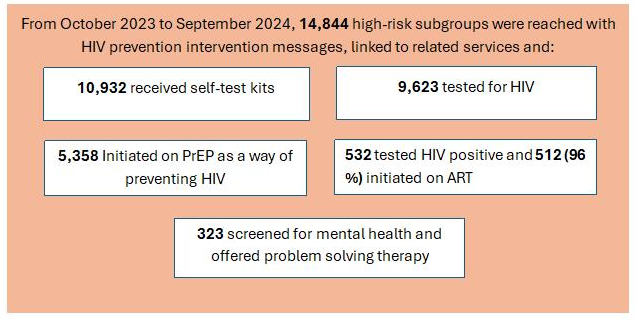
- Screened 657 individuals at high risk for common mental disorders (between 2022 and 2024) and delivered Problem-Solving Therapy (PST) using the Friendship Bench model.
- Referred and linked clients as needed to mental health and psychosocial services as part of integrated care.
Complementary & empowerment activities
- Delivered economic-strengthening or livelihood-linked interventions and life-skills support as part of comprehensive engagement (supporting informed sexual health decision-making).
Outcomes
- Capacity strengthened: Over 400 HCWs and 85 community cadres trained across 23 facilities increased facility trust and accessibility for high-risk groups.
- HIV prevention scale: more 2 million condoms distributed; PrEP reach and initiations expanded dramatically (1,815 → 12,172 across 20 districts); 70%+ linkage to PrEP among eligible high-risk individuals; 52% month-1 PrEP continuation. CAB-LA demand created via pilots at 3 public sites.
- Increased service uptake & linkage: 1,000+ outreach initiatives reached 34,350 high-risk individuals; 4,000+ HIV self-test kits distributed; 2,600+ screened for STIs with 99% linkage to treatment for positives.
- Improved treatment outcomes: Peer support and adherence programming contributed to ≥95% of participants achieving undetectable viral load or low viremia.
- Mental health integrated into services: 657 high-risk individuals screened and offered PST via Friendship Bench between 2022–2024.
- Behavioural & empowerment impacts: Better community understanding of HIV prevention, reduced risky behaviour, and more informed sexual-health decision-making among target groups.
Monitoring and Evaluation
- Use of data systems to monitor HIV care cascade: testing, linkage, retention, viral suppression.
- Quality improvement and health system strengthening approaches embedded in implementation to enhance service delivery.
- Continuous capacity building of health workers and community cadres for sustainability.
Resources
Access Care and Treatment Resources Here.
